
Indian granite vs Chinese granite for UK headstones
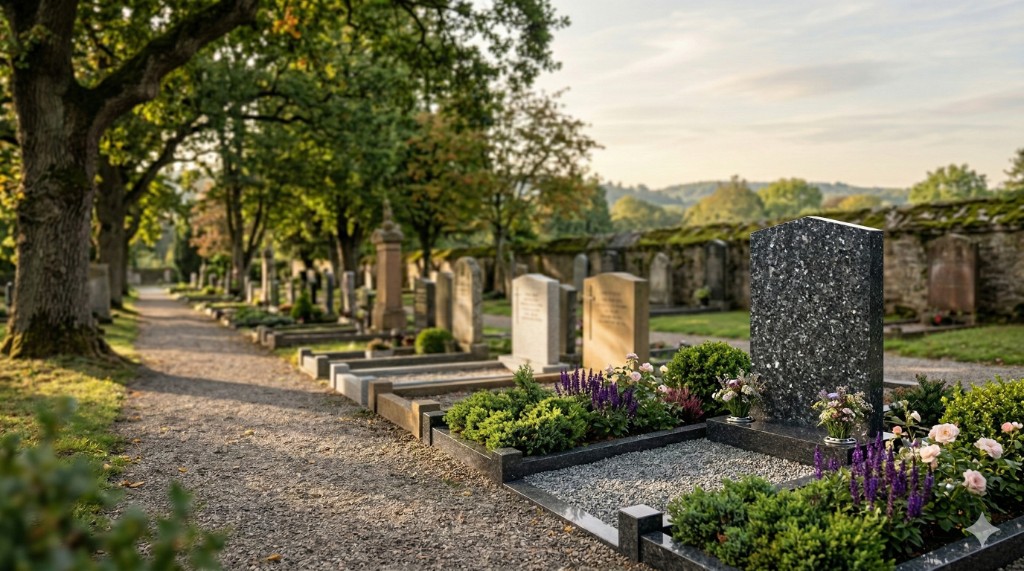
Most UK headstones are granite. The question families rarely get a straight answer to is which granite, and from where. Two slabs can both be sold as “black granite” and behave very differently after ten British winters.
Sandalwood Memorials specifies Indian granite for every granite memorial we make. We do not use Chinese granite. That is a materials policy, not a slogan. Indian stone usually costs a little more at the quarry and in the workshop. We would rather explain that on a quotation than use a cheaper slab that is harder to letter, harder to match later, or quicker to lose its polish.
This is not a claim that every quarry in China produces poor stone, or that every quarry in India produces the same grade. Origin is a starting point. Grade, density and how the block is selected still matter. Our choice is to buy Indian granite we can stand behind on a lawn memorial, a kerb set and an added inscription years later.
What “black granite” actually means
In the memorial trade, “granite” is used for a family of hard igneous rocks that take a polish. Indian Absolute Black, and the dark and light Indian greys we also use, are the stones UK masons have cut, gilded and fixed for decades. They are dense, even in grain, and they take gold, paint and enamel lettering cleanly.

Chinese black stone is widely exported into the same market, often at a lower price. Some of it is a different rock sold under a granite label. Some of it is a lighter or more open grain that still looks dark when wet on a showroom floor. Once it is outside, rain, frost and lichen show the difference. We would rather not discover that on a family’s memorial.
Why Indian granite suits a UK cemetery
A headstone has to stand in rain, freeze–thaw and, in cities, pollution. Indian black and grey granites of the grades we buy are close-grained. That helps in three practical ways:
- Polish. A tight grain holds a mirror polish. Cheaper, more open stone can look cloudy sooner, especially on the face where the inscription sits.
- Lettering. Cut, sandblasted, painted and gilded letters need a stable surface. Indian black granite gives strong contrast for gold. Indian greys take darker lettering without the face looking speckled into unreadability.
- Later work. Families often come back to add a name. Matching an Indian slab we already know is more reliable than matching an unnamed import from years earlier. See adding a name to a headstone.

Cleaning is gentler on a dense polish too. Harsh chemicals damage lettering on any granite; a close grain at least starts with a surface that can be washed with water and a soft cloth, as we describe in headstone cleaning.
Why it costs a little more
Indian granite is not a luxury finish we add for show. It is usually dearer because the blocks we specify are a tighter grade, and because we will not substitute a cheaper Chinese slab to win a price comparison. The extra sits in the stone, not in a longer inscription or a larger shape.
Catalogue prices already include the granite we use, with installation and VAT, on lawn memorials, kerb memorials, garden kerb sets and cremation memorials. Cemetery fees and inscriptions are extra, as the product pages state. We do not publish a separate “Chinese granite discount”. If another quotation is much lower for a similar size, ask which country the stone comes from, and whether the same slab can be matched in five years.
Colour is still a separate choice
Indian origin does not mean every memorial is black. We also use Indian dark grey, light grey and warmer Indian colours such as aurora, shown on the materials and colours guide. Blue pearl and some other named granites are different quarries again; when we offer a colour, we will say what it is. We will not describe Chinese stone as Indian, or the other way round.
Marble, where a cemetery still permits it, is a different material with different weathering. This article is about granite, which is what most UK lawn and kerb memorials are cut from.
What this means when you choose a design
Start with the cemetery section, then the shape, then the granite. A 3ft ogee lawn memorial in Indian black granite is a different object from the same outline in a cheaper import, even if both photographs look dark on a phone. Browse current designs and prices in the memorial catalogue. If the plot is an ashes space, use the cremation memorials range rather than scaling down a burial headstone.
We cover this from both showrooms: Muswell Hill for London and surrounding counties, and Malin Bridge for Sheffield and the wider Yorkshire coverage. Visits are by appointment. The granite policy is the same in both places.
Questions worth asking any mason
- Which country is this slab from, and can that be written on the quotation?
- If we add a name later, can you still obtain a matching granite?
- Is the price for the granite you showed us, or a substitute if that block runs out?
- Does the cemetery need to approve the material as well as the size? Many do. Work remains subject to cemetery approval.
If you want Indian granite as a matter of course, you do not have to negotiate it with us. Send the cemetery or churchyard name through the enquiry form. We will quote the memorial in the Indian granite that suits the design, with a written lead time, rather than a stone we would not put our name on.